An AI tutor is the biggest opportunity in education, and one of the hardest things to build
Why one-to-one teaching is the biggest opportunity in education, and why a tutor is so much harder to build than a chatbot.
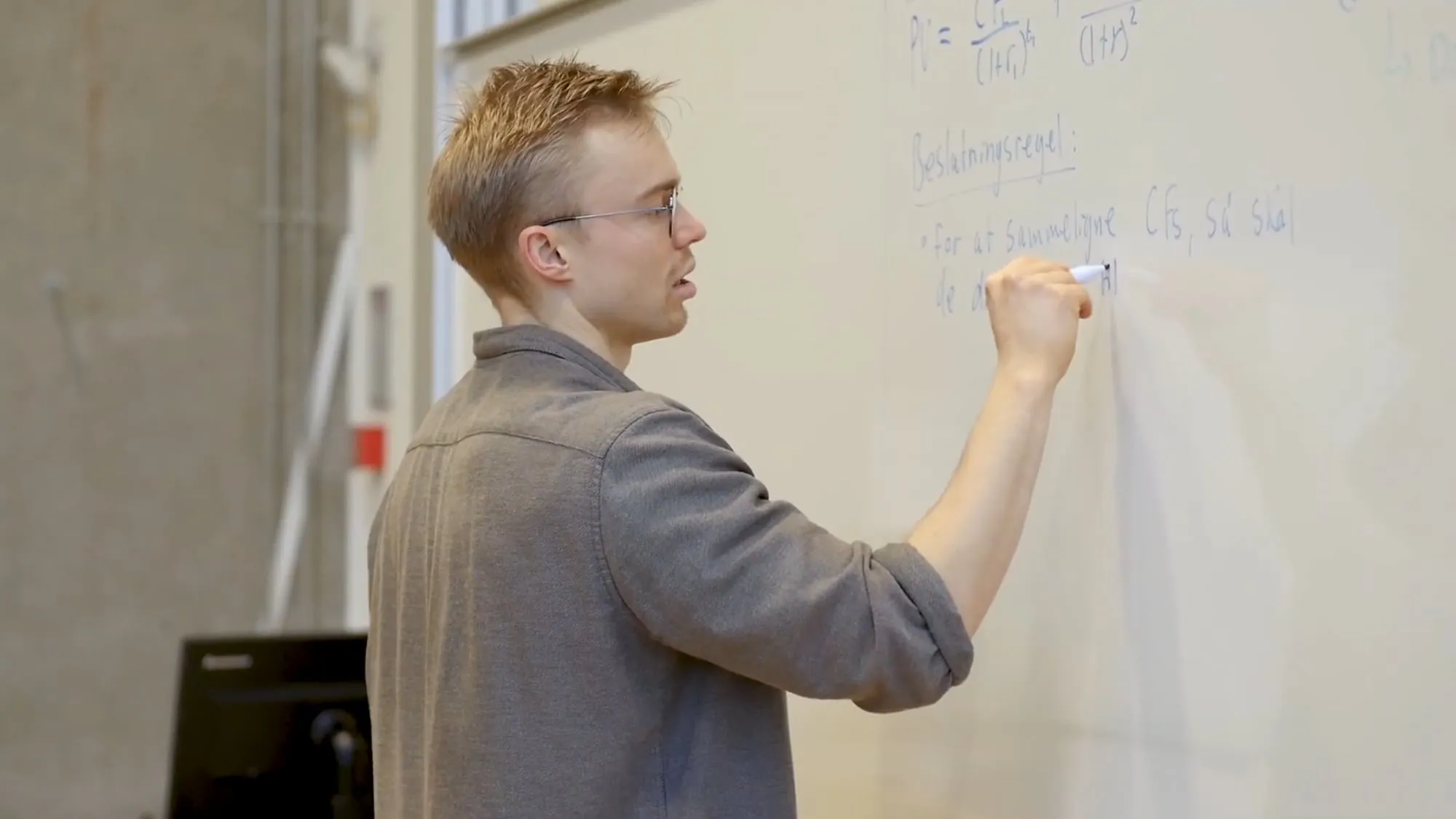
I have taught more than three thousand university students, most of them in groups of more than a hundred at a time. You can make a big and meaningful difference as a lecturer, and most teachers do.
But the model we have today is one to many, and it has a limit, however hard you work. It is simply not possible to personalize the teaching when you stand as one teacher in front of hundreds of students. They have different needs, different levels and different interests.
Teaching one to one has not been possible before, but we have always known that it has immense potential. Not as a full replacement for the model we have today, but as a complement, where we elevate both teachers and students. And this is not only my own experience. The research says the same.
The opportunity: one-to-one teaching for everyone
In 1984, Benjamin Bloom showed that students who were tutored one to one performed up to two standard deviations better than students in ordinary classroom teaching, which corresponds to the difference between an average student and a top student (Bloom, 1984). It is one of the most remarkable results in education research.
But it has never been possible to offer it at a societal level. There are far fewer teachers than students, so one to one has been reserved for the few who could pay for it. The school model most of us grew up with was created during the industrial revolution, with the assembly line as its logic: many pupils, one teacher, the same material at the same pace.
For the first time, we have the technology to change that. AI has many good uses in education, from less administration and more objective grading to teaching material that can be made in a fraction of the time. Those are all great, but personalized learning is what could change how much each student learns.
It is also one of the hardest things to build. Think about all the things a great teacher or tutor actually does.
What a good tutor does
A tutor picks up far more than text. She sits next to the student and sees the work on the page, not only the final answer. She hears when the student hesitates just before a wrong step, sees the frustration growing, and can see it in their face when something finally falls into place. A chat gets none of that. It only sees what the student typed in the end.
A tutor grounds herself in the student’s own material. She works from what the student brought: the chapter, the slides, the exercise that is giving them trouble. The student is sitting a specific exam, after all, not a generic version of the subject. She of course knows more than what is in the books. If the student moves outside the material, she still helps, but says that it is not part of the course, even if it is worth talking about.
A tutor does more than answer. Answering is the easy part. A tutor wants the student to learn as much as possible, and that is far harder than just giving information. When a student asks a question, she does not just give the answer. She guides, gives a hint, draws it out, and sometimes she lets the student stay stuck for a moment. The goal is for the student to arrive at the answer themselves, because that is when something is actually learned.
A tutor follows the development of the student. She remembers how far the student has come, what is hard and what is going well. She goes back to the gaps and challenges more where there is room for it. It is the hardest part to build, and a chat does not even try.
The research shows that what matters is how AI is built and used. Students who wrote essays with ChatGPT showed the weakest brain activity of every group measured, and most could not quote from their own essay minutes later (MIT Media Lab, 2025). Used as a sparring partner or tutor instead, AI has the opposite effect. In a randomized trial at Harvard, students with a purpose-built AI tutor learned more than twice as much as students in ordinary, active teaching, and in less time (Harvard, 2025). The tutor I have described above does not fully exist yet. That is the one we are building at alice.
| A tutor | A chatbot |
|---|---|
| What comes in | |
| The text you typed |
| What happens inside | |
| Picks the most likely reply |
| What comes out | |
| Gives the answer |
Why it is hard, and how we are building it
Learning has been alice’s mission from the beginning, but alice did not start as a tutor. We started with a study platform with the tools a student needs: notes, exercises, exam simulations and a chat for looking things up in the material. It has helped more than 100,000 students. But we believe we can do much better. Not just a little more learning, but a real step change in how much each student learns. That is where we have put our R&D, and today the tutor is the center of alice, with everything else as tools around it.
Some of this will be solved over time. The technology is quickly getting better at understanding more than text, like speech, images and the student’s own material.
Getting the student to learn as much as possible is different, because it goes the opposite way of the technology. A language model is built to give the answer, fast and complete. A tutor has to hold the answer back, lead the student to it, and know when one or the other is right.
It is also hard to test. Learning is individual, many factors are at play, and it often only shows weeks later, in the exam. If we measured alice on how much it is used, we might build the wrong thing without noticing.
That is why we are inspired by the best teachers. We do not think we can calculate our way there purely technically. But by looking at what really good teachers do, and with a lot of role play in the team on how a good teacher would handle different situations, we can build a fantastic tutor over time.
In practice, the student’s plan decides what has to be learned, down to the knowledge block. The tutor decides how to get there, and it has the tools we believe work for learning. It can draw, for example, but it is up to the tutor to judge when that makes sense.
What is a knowledge block?
alice breaks a course down into chapters, lessons, and at the lowest level knowledge blocks. A knowledge block is meant to be the smallest building block of learning, the smallest thing you can actually learn, such as “present value of a single cash flow” rather than “finance”. That is the ideal. In practice the line is not always that sharp. Knowledge blocks are what the tutor tracks, so that we know a student has learned something rather than just seen it.
The first version of the tutor we built was too polite, talked too much and did not adapt enough to the student it was talking to. A student who already knew the material was walked through it anyway, and a student who was lost got the same pace as everyone else. The solution was to say less, steer more and check what has actually sunk in.
None of this is about replacing teachers. Imagine that you as a teacher could multiply yourself by ten or a hundred. An assistant that teaches by your principles, works one to one with each student and reports back to you on where you do the most good. If many of them are stuck on the same thing, you can put your time exactly there. Or you free up time for the relationships in the room, which are often just as important. And the student gets something almost no one has today: their own tutor.
Where we are today
The tutor is still in beta, and it is moving fast.
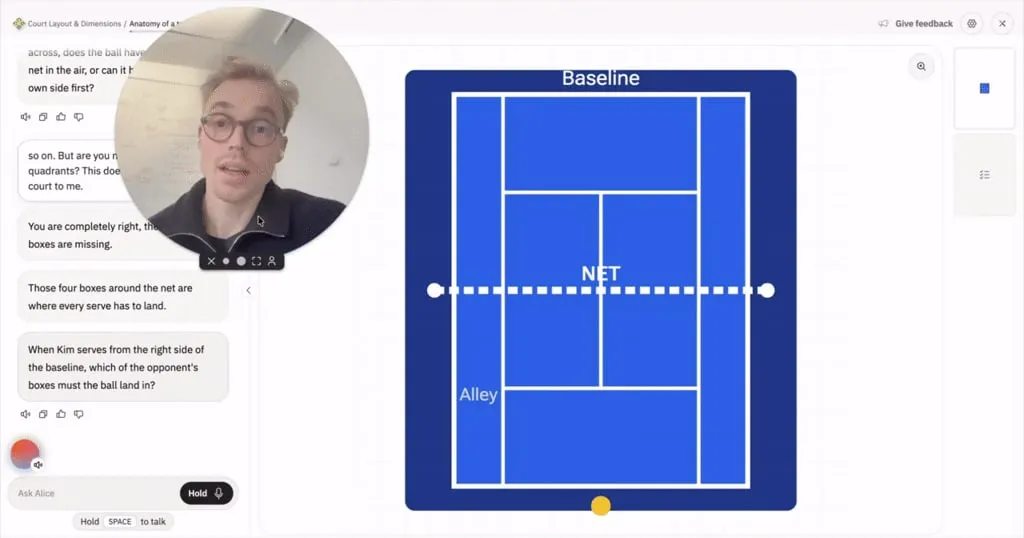
It has moved on a lot since this recording. Try the current one on your own course
There is a lot a good human tutor does that ours cannot do yet. It cannot see you through the camera, so it cannot see that you are struggling before you say so. But it can still hear if you hesitate. And you cannot yet draw together with it on a shared whiteboard. There are many more.
But some things it already does really well. It works from your own course material, it explains by drawing, and you can talk to it by voice in your own language. Some students tell us they learn far more with it than in ordinary teaching. That motivates us to keep going. There is nothing I would rather build than one-to-one teaching for everyone.
alice is built to be that tutor. It knows your course, guides instead of answering, and tests you until it sticks. Try it on the course you are in right now.
Kim Rants, founder and CEO of alice