I started an AI company, but I think the AI bubble is about to burst
The technology is real, but I expect the big AI stocks to fall at least 30% within a year.

I am very bullish on AI. It is why I left McKinsey to start alice almost three years ago. But for about a year, I have said that we are in an AI bubble, and now I think it is about to burst. Today’s AI valuations assume that most companies will adopt AI and get much more real value out of it within a few years, but in my experience, people do not change that fast, and value capture will be slower as a result. Meanwhile, more and more of the AI build-out is paid for with borrowed money that is getting more expensive, and the interest has to be paid long before most people change how they work.
I expect the big AI stocks to jointly fall at least 30% from today’s prices within a year. Examples could be Nvidia and Oracle. I could quickly look like a fool, and being more than a year early is almost as good as being wrong. For example, I will be wrong if AI revenue keeps growing fast enough to catch up with the spending, or if interest rates start to drop significantly.
The short version
- The technology is real, but people have gotten ahead of themselves, and the valuations are now too high.
- Growth is slowing, and the real profits are far from what the valuations need.
- It is starting to crack where the debt is, and rising interest rates add pressure.
- A few good companies will come out as winners, but the burst will destroy a lot of wealth and many companies.
You can believe in AI and still think the market is wrong
When I say we are in a bubble, I sometimes get the question why I then build an AI company. To me, those are two very different things. One is about what the technology can do, the other is about what the market pays for it. A technology can be real and still be priced far too high, and most people in the industry have every reason to talk the valuations up. I think it is more useful to say what I actually see. And I believe AI can do a lot of good. A personal tutor for every student is one of the best examples I know, and that is why I build alice.
AI companies have real revenue, but the valuations have run too far ahead
Unlike many dot-com companies, the leading AI companies have real customers and real revenue. We experience this at alice too, on a small scale. We have students who love using the product and gladly pay for it. A much better-known example is of course Anthropic, whose revenue jumped from $4.7 billion in the first quarter to $11.6 billion in the second and $16.8 billion in the third. But growth is slowing. Revenue rose by $6.9 billion in the second quarter and $5.2 billion in the third, so quarterly growth fell from almost 150% to about 45%. That is still extraordinary, but the valuations need years of it.
Amazon, Alphabet, Meta and Microsoft will invest over $700 billion this year, much of it in AI data centers. Sequoia’s David Cahn estimates that one year of this spending needs about $1.5 trillion of revenue from end customers to pay off, because both the cloud provider and the AI company selling to you need a margin. Spread over the five to six years the chips are assumed to last, that is $250 to $300 billion a year, and each new year of spending adds more. OpenAI and Anthropic, the two biggest AI labs, bring in revenue at a rate of about $120 billion a year together, less than half of that. Other AI revenue, such as Microsoft’s, narrows the gap, but part of it is the labs paying for computing power.
Valuations need hypergrowth, but people change slowly
The bull case deserves respect. On paper, the big tech companies are very profitable, and in September the S&P 500 traded at about 19 times expected earnings, only about 10% above its 30-year average. The froth is in the private AI labs, and the stocks most at risk are those whose earnings depend on the build-out, like Nvidia and Oracle. Their shares do not look expensive on today’s earnings forecasts, but those forecasts assume the build-out keeps growing. Investors have discussed valuing Anthropic at $1.5 to $2 trillion, 22 to 30 times its third-quarter revenue of $16.8 billion multiplied by four to approximate yearly revenue. At the market’s 19 times earnings, that would need yearly profits of $80 to $105 billion, more than its entire revenue today. According to Reuters, the case for that price rests on Anthropic’s own forecast of $190 to $200 billion of revenue in 2028, about three times its current pace.
I find that hard to believe. I have worked with technology transformations for years at McKinsey, and they almost always take longer than anticipated. Change is difficult and people tend to move slowly, especially large groups of people. This will not be different. Some people will adopt AI very quickly, but the majority will not.
I think AI will make the world much richer, but it will take longer than the optimists expect.
Four reasons I think the bubble is about to burst
Slower-than-anticipated adoption is why I think the valuations, and the earnings forecasts behind them, are too high, but valuations can stay too high for years. Four things make me think the bubble is about to burst, ranked by importance.
1. The real profits are far from what the valuations need
Fast growth is not the same as profitable growth. OpenAI burned $3.7 billion in the first quarter on $5.7 billion of revenue, according to The Information. Its gross profit of about 39 cents per dollar of sales does not cover the billions it spends training the next model, and it cannot stop training, because the best open models, which any company can download and run on its own servers, trail the best closed ones by only about four months on average. That is a treadmill, not a moat. Anthropic’s positive cash flow in the third quarter is impressive. But customers pay extra for the best model, and as all the models get very good, having the very best matters less, so customers may stop paying as much extra for it. If so, I do not see how Anthropic earns the profits its valuation needs, or how the labs keep paying for ever more computing power.
Even the giants’ profits look better than they are. Alphabet’s record profit of $112 billion in the second quarter included $98 billion of other income, mostly unrealized gains on its stakes in SpaceX and Anthropic, and Nvidia booked $23.7 billion of such gains in the first half of its fiscal year, about a fifth of its net profit. Those are mostly paper gains that can reverse as quickly as they came. And if new chips make AI servers obsolete faster than the giants’ accounts assume, today’s profits are overstated.
2. The debt is piling up, and the weakest links are cracking
Some of the giants now borrow to build. Alphabet’s free cash flow turned negative in the second quarter, and Alphabet, Amazon, Meta and Oracle have sold over $228 billion of new bonds this year. CoreWeave, which rents out AI computing power, had a second-quarter interest bill five times its adjusted operating profit, and its bonds yield over 15%, a sign that investors doubt they will be repaid in full. Both CoreWeave and Oracle, which S&P rates one notch above junk, depend on OpenAI, and about half of Oracle’s $638 billion order backlog is tied to it. If lenders pull back, the build-out slows, and Nvidia’s sales follow.
3. The money goes in circles
Some of the biggest buyers of AI chips and computing power are financed by the companies that sell to them. Nvidia has invested $30 billion in OpenAI and agreed to guarantee up to $105 billion of OpenAI’s lease and power payments for an Ohio data center that will run only Nvidia chips. OpenAI pays cloud providers like Oracle and CoreWeave for computing power, and they buy Nvidia’s chips, so part of the money behind Nvidia’s sales started with Nvidia.
When a supplier finances its own customers, its sales look stronger than the real demand, and if the customers cannot pay, it loses both the money and the future orders. That happened to Lucent, then one of America’s largest telecom equipment makers. In 1999, it had committed about $7 billion in loans to young telecom companies so they could buy its equipment. When many went bust, the loans went bad, the orders stopped, and Lucent’s share price fell from $84 to under $1. Nvidia is far more profitable than Lucent was, but the pattern is familiar.
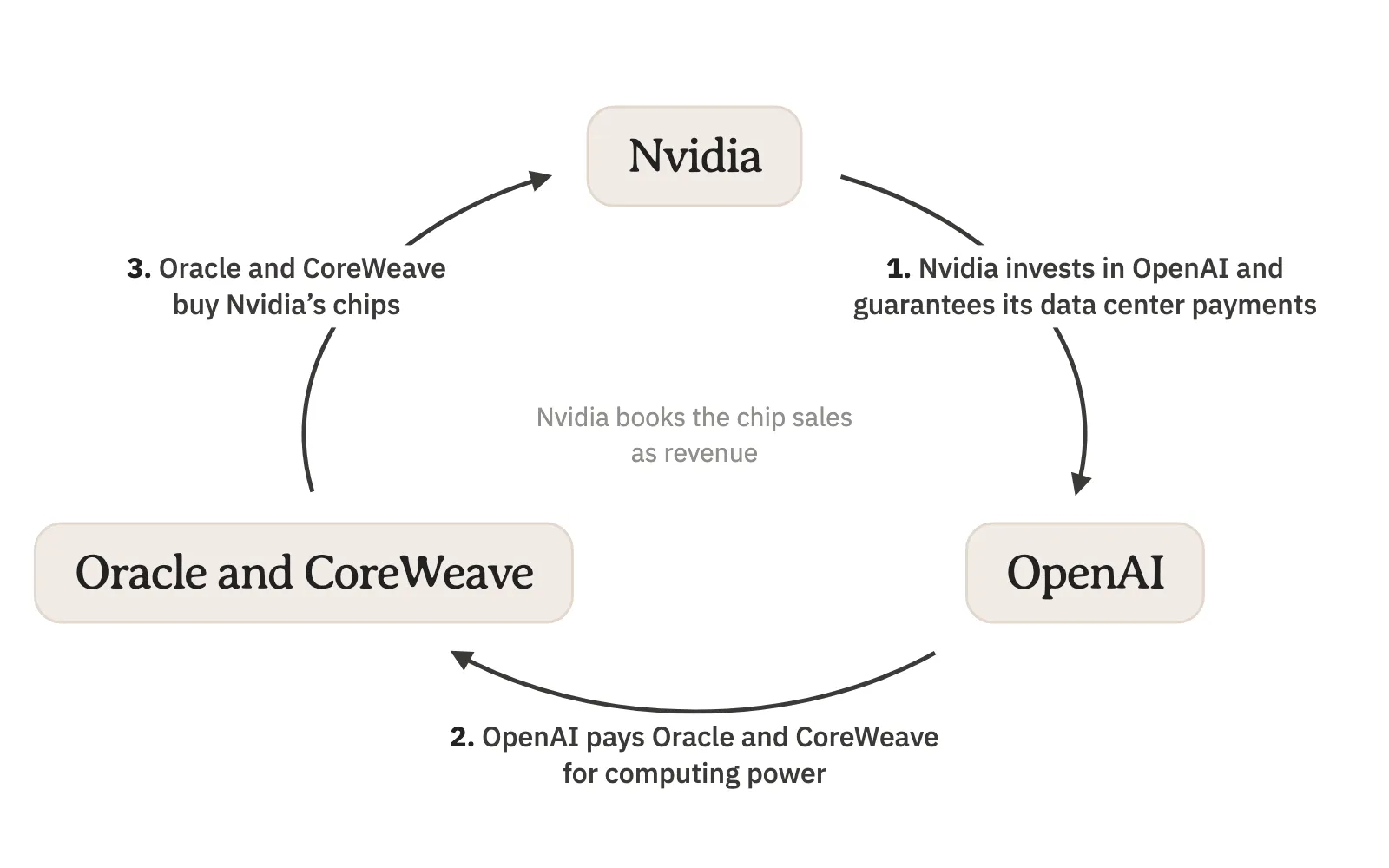
How money flows in a circle between Nvidia and its customers.
4. Money is getting more expensive
The formula on the whiteboard in the photo above shows why rates matter. A company is worth its future cash flows discounted to today, and most of the AI companies’ value sits far in the future, where higher rates cut it the most. Higher rates also make the debt more expensive. The Fed raised rates in September for the first time since 2023, and the 10-year Treasury yield hit its highest level since 2002 in early October. It has eased a little since, so I see rates as added pressure, not the trigger.
I am still very bullish on AI
Carlota Perez, who has studied technological revolutions for decades, says she has “not seen a golden age happening without a crash”, and I think AI will follow that path. The crash might not be an explosion, because the big tech companies are solid businesses. But it could be a slow boil, where the correction happens over several months. In the dot-com crash, the Nasdaq fell 78%, and Cisco, the Nvidia of that build-out, needed more than 25 years to regain its 2000 share price. Many companies will not survive, especially those with the most debt, but a few will come out as clear winners, as Amazon did after the dot-com bust.
When the bubble bursts, raising money will be harder for AI startups, alice included. It does not change what we build. We try to build something people want and love, with a group of very talented people, because if we do that, there will be value, there will be a business, and we will be fine. And helping students learn is a very meaningful mission, which we are proud of. But the risk of a burst does change how we spend. I am less obsessed with growth and more with retaining users and building something they love to use. And we only spend money on growth when we see evidence that it is profitable, even if that means we reach our revenue targets later. I believe alice will be among the winners. We are building an AI study platform, and if you want, you can try it here.
Do you think we are in an AI bubble? And if so, where does it break first?
Disclaimer: This post reflects my personal views and is not investment advice or a recommendation to buy or sell any security.
Sources
- Reuters, citing an investor, October 2026: Anthropic’s revenue by quarter
- Inc, citing Reuters, September 2026: Anthropic’s first-quarter revenue in its IPO filing
- Platformonomics, July 2026: big tech capex guidance
- David Cahn, July 2026: AI’s $1.5 trillion question
- GPU Insights, 2026: server and chip depreciation
- Quartz, citing the FT and CNBC, October 2026: OpenAI’s annualized revenue of about $50 billion
- Techzine, August 2026: Microsoft’s $24.1 billion of revenue from OpenAI
- J.P. Morgan Guide to the Markets, September 2026: S&P 500 forward P/E and 30-year average
- Reuters, October 2026: Anthropic IPO valuation talk
- The Next Web, citing Reuters, August 2026: Anthropic’s 2028 revenue forecast behind its IPO valuation
- The Decoder, citing The Information, June 2026: OpenAI’s first-quarter revenue, cash burn and gross margin
- Epoch AI, 2026: open-weight versus closed models
- Axios, October 2026: Anthropic cash flow positive in the third quarter
- Alphabet, Q2 2026 10-Q: record profit, other income and gains on equity stakes
- Shacknews, citing CNBC, July 2026: SpaceX and Anthropic stakes behind Alphabet’s other income
- Nvidia, Q2 fiscal 2027 results: net income and gains on equity securities
- Alphabet, Q2 2026 earnings release: free cash flow
- investingLive, citing LSEG, October 2026: big tech bond issuance
- CoreWeave, Q2 2026 results: interest expense and adjusted operating income
- Computing, citing S&P, July 2026: Oracle’s downgrade and its backlog tied to OpenAI
- DCD, September 2025: OpenAI’s commitments to CoreWeave
- Reuters, 19 October 2026: CoreWeave’s bonds
- Investing.com, May 2026: Nvidia’s $30 billion investment in OpenAI
- Axios, August 2026: Nvidia’s guarantee for OpenAI’s Ohio data center
- Fortune: Lucent’s loan commitments to customers
- NJBIZ, 2006: how Lucent fell
- Federal Reserve, September 2026: rate decision
- Bloomberg Government, October 2026: 10-year yield at a 24-year high
- Irish Times, republishing the FT, August 2025: Carlota Perez
- Fortune, 2015: the Nasdaq’s fall from 2000 to 2002
- Bloomberg via Yahoo Finance, December 2025: Cisco
Kim Rants, founder and CEO of alice